The main purpose of this ongoing blog will be to track planetary extreme, or record temperatures related to climate change. Any reports I see of ETs will be listed below the main topic of the day. I’ll refer to extreme or record temperatures as ETs (not extraterrestrials).😜
Here is a new feature for this blog, which I will add daily. This is the latest inciteful Green News Report from my friends Desi Doyen and Brad Friedman at Progressive Voices. Hit ‘continue reading,’ listen, then hit return to see my daily topics:
Main Topic: Inequality Causing 100,000 Extra Deaths a Year from Heat and Cold in Europe
Dear Diary. Inequity among economic classes has been with us since man first discovered agriculture when some people started to get rich by having a set of people become worker bees. Fast forward to the 21st century and the poor are still with us as capitalism rolls along making some filthy rich.
Here in the U.S., there is a concerted evil movement to undo all of the social safety nets put into place by Presidents Roosevelt and Johnson. Here most poor people have access to air conditioning or heating though, even those who are homeless that can go to shelters. However, those from lower classes may not dwell in well insulated homes or are forced to work in extreme heat, so they are susceptible to succumbing to extreme heat or cold.
The same is true across Europe despite stronger social safety nets. Apparently, some European areas still have dwellings that don’t have air conditioning, which can and has led to thousands of deaths. Here are more details from the Guardian:
Inequality causing 100,000 extra deaths a year from heat and cold in Europe
Findings come after third-hottest April on record globally and amid fears of more brutal European summer weather
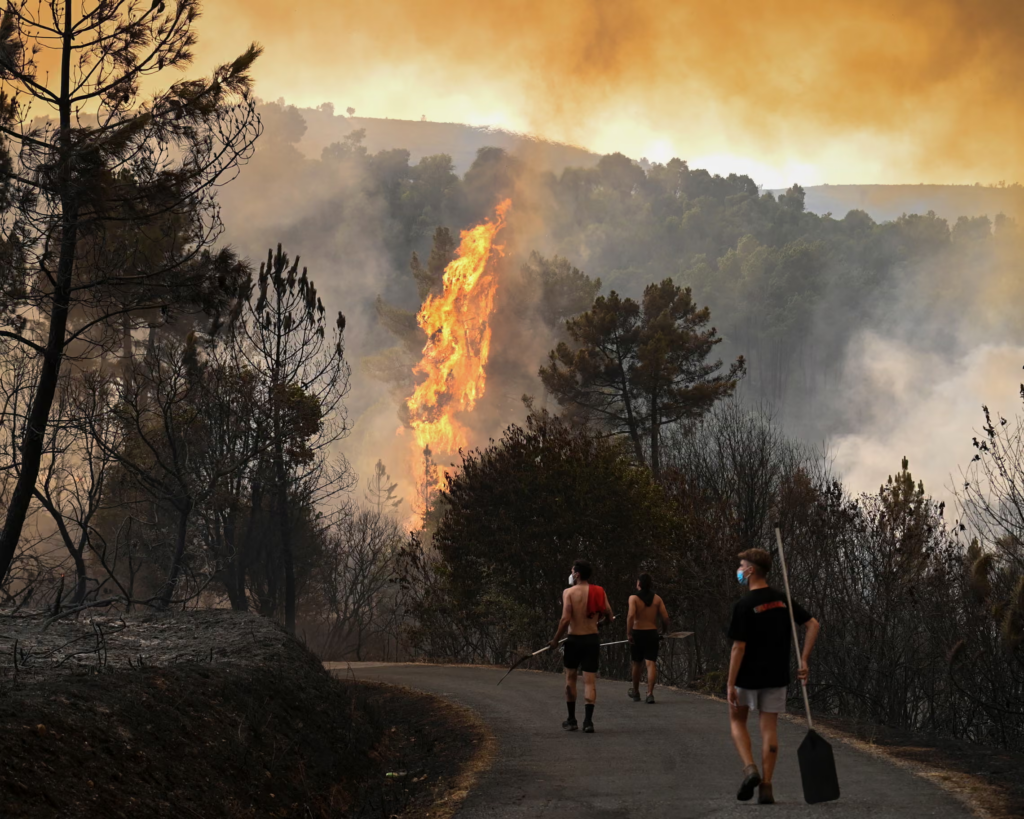
A wildfire burning in Spain last summer. Researchers found high death tolls from heat and cold were associated with indicators of hardship. Photograph: Miguel Riopa/AFP/Getty Images
Ajit Niranjan Europe environment correspondent
Fri 8 May 2026
Economic inequality adds more than 100,000 deaths to the vast toll from heat and cold in Europe each year, research has found.
Cutting levels of inequality to match that of Europe’s most equal region, Slovenia, as measured by the Gini index, would reduce temperature-related mortality by as much as 30%, equating to 109,866 people, the study found.
The findings come after the EU’s Copernicus monitoring project ranked last month as the third-hottest April on record globally, with some countries such as Spain recording their hottest April on record. The return of the natural heating phenomenon El Niño – which may shape up to be unusually strong – has raised fears of a brutal European summer in 2026.
The researchers found high death tolls from heat and cold were associated with several indicators of hardship, such as poverty and the inability to heat a home.

As well as lowering inequality within regions, cutting severe material and social deprivation across the continent to the level of central Switzerland, the least deprived region, would result in 59,000 fewer heat and cold deaths, according to the study. Increasing it to the level of south-east Romania, the most deprived region, would result in 101,000 more temperature-related deaths.
The research is the first to quantify the effect of socioeconomic troubles on the lives lost during Europe’s bone-chillingly cold winters and scorchingly hot summers. The researchers said it added weight to calls to target short-term relief to vulnerable groups and, in the longer-term, reduce structural inequality in Europe.
“It’s a two for one,” said Blanca Paniello-Castillo, a biomedical scientist at the Barcelona Institute for Global Health and lead author of the study. “If the equity perspective would be more included in policies – European, national, local, whatever – we would be hitting two goals at the same time.”
Heat and cold stress the body, leaving it more susceptible to disease and less able to fight it off. Mortality rises sharply when temperatures deviate from a comfortable range, particularly among people who are old or ill.
The analysis, which looked at daily mortality data for 654 regions in Europe between 2000 and 2019, estimated “attributable deaths” by modelling the health burden if all regions had the best and worst values they found for each economic indicator.
They also found richer regions suffered fewer cold deaths – probably owing to insulated homes, better healthcare and less energy poverty – but more deaths during heat. They suggested this may be the result of the urban heat island effect, with cities enjoying greater wealth but suffering from higher temperatures because of asphalt and a lack of green space.
They consistently found high temperature-related mortality was associated with indicators such as the Gini index, which measures inequality in a population’s income distribution, difficulties in keeping the home warm, and material and social deprivation. They did not explicitly include penetration of air conditioning as a variable.
Usama Bilal, an epidemiologist at Drexel University’s Dornsife School of Public Health, who was not involved in the research, said the study was of high quality and used robust methods, though it may have been difficult to separate poverty from other climatic aspects. “The main limitations I see relate to the level of measurement of social variables, and the fact that in Europe – and many other places – there is a correlation between warmer climates and poverty, excluding eastern Europe.”
Cold is currently a far greater threat to human health than heat, though scientists project that relationship will flip as global heating pushes temperatures higher. Last month, scientists found temperatures in Europe have risen by 0.56C per decade since the mid-1990s – faster than any other continent on the planet – owing to the blanket of fossil fuel pollution covering the Earth.
The findings come after of a warning by the EU’s scientific advisers that the continent was failing to properly adapt to climatic shifts.
Malcolm Mistry, an epidemiologist at the London School of Hygiene and Tropical Medicine, who was not involved in the study, said the findings should help shape climate adaptation policy, and that the results may be conservative.
“For instance, though the authors understandably restricted their study to pre-Covid-19 pandemic years, fuel poverty rates – an important determinant identified in the study, in particular, rose quite sharply across many European countries after 2021-22,” he said. “The estimated burden presented here may well be conservative by current standards.”
Here are some “ETs” recorded from around the U.S. the last couple of days, their consequences, and some extreme temperature outlooks, as well as any extreme precipitation reports:
Here is More Climate News from Saturday:
(As usual, this will be a fluid post in which more information gets added during the day as it crosses my radar, crediting all who have put it on-line. Items will be archived on this site for posterity. In most instances click on the pictures of each tweet to see each article. The most noteworthy items will be listed first.)