The main purpose of this ongoing blog will be to track planetary extreme, or record temperatures related to climate change. Any reports I see of ETs will be listed below the main topic of the day. I’ll refer to extreme or record temperatures as ETs (not extraterrestrials).😜
Here is a new feature for this blog, which I will add daily. This is the latest inciteful Green News Report from my friends Desi Doyen and Brad Friedman at Progressive Voices. Hit ‘continue reading,’ listen, then hit return to see my daily topics:
Main Topic: Anxiety as UK Homes, Roads and Railways Start Sinking into the Sea
Dear Diary. I can’t imagine what I would do if I lost my home to a tornado, although if I survived the event friends would come to my rescue. Obviously, I don’t live by the sea, so I will not have to worry about my home getting swallowed by rising seas due to climate change, but many people do as the climate crisis deepens.
Earth’s oceans are enticing with much beauty to offer. It’s no wonder that down through the ages people have wanted to build beach homes as close to the water as possible. Now many are beginning to regret that decision as ocean levels start to rise from Greenlandic and Antarctic glacial and ice melt.
We have a case in point today from the Guardian. Unfortunately, the frequency of these reports will increase as we move further into the 21st century.
‘There is no great master plan’: anxiety as UK homes, roads and railways sink into the sea
Increasing coastal erosion has hit communities’ livelihoods and put lifestyles under threat

The road at Slapton Sands, South Devon, which was destroyed in February. Photograph: Jim Wileman/The Guardian

Sat 23 May 2026
The remains of the road linking two towns in south Devon lie crumbled on the foreshore in a mess of tarmac, steel and concrete.
The dramatic coastal road, known as the Slapton Line, has an environmentally protected freshwater lake on one side and the sea on the other, and links the towns of Kingsbridge and Dartmouth. But this year, winter storms demolished a section of the A road between Torcross and Slapton, which is at the frontline of rising sea levels and coastal erosion, fulfilling a destiny that was predicted more than 30 years ago, but that has not been prepared for.
On bank holiday Monday, hundreds of people will walk the route of the road as the tourist season begins in earnest, to highlight how its collapse has hit their livelihoods and put lifestyles under threat.
“It is just worrying that nothing is being done,” says Gill Sterry, owner of the Sea View campsite. “I know it takes a long time but its been three months now. Something could have been done to improve the road – even just a little bit of tarmac in places. We feel forgotten about.”
The rubble in Devon is evidence of what a committee of MPs say is a total lack of national preparedness for how to tackle the inevitable erosion of land beneath the feet of coastal communities all over the UK.
“No great master plan has slipped into place. There isn’t one,” says Dan Thomas, cabinet member for highways and transportation at Devon county council, as he contemplates the £18m cost of repairing the road, which would not even include defences. “£18m out of our whole capital budget for transport of £80m – almost 25% of that budget for a year: that is a sucker punch that the council cannot take.”
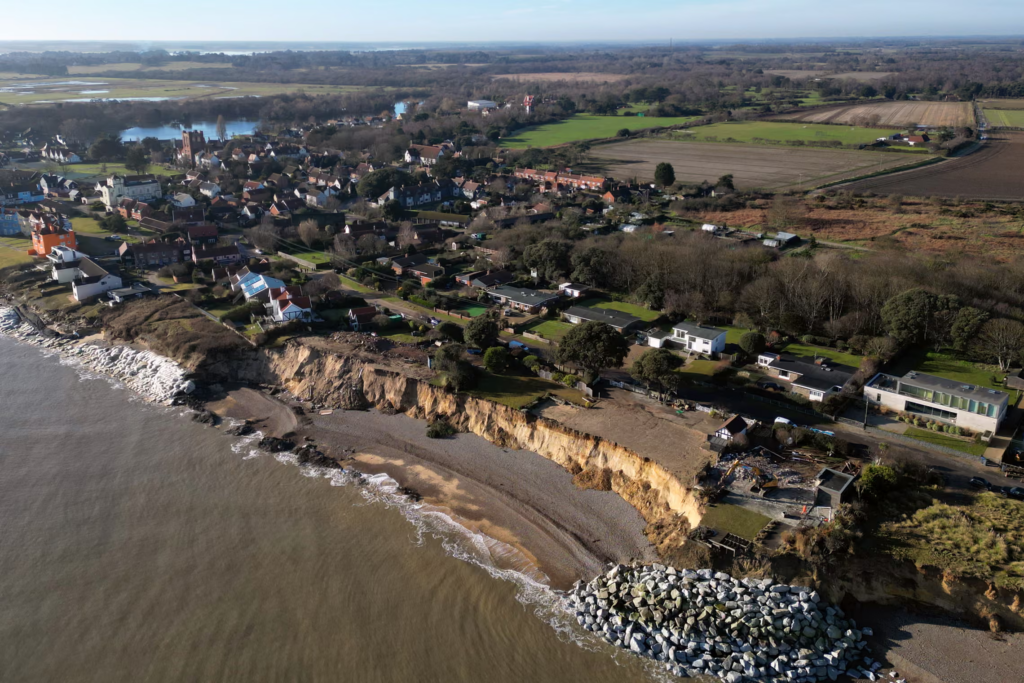
From the East Riding of Yorkshire, where the soft cliffs of boulder clay at Holderness are retreating at rates of up to 4.5 metres per year – some of the highest rates in Europe – to the north Norfolk coast, to Suffolk and down to the Isle of Wight, communities are at the forefront of an eroding coastline, the retreat accelerated by the climate crisis.
More than 10,000 properties, rising to 20,000 according to some calculations, are at risk from coastal erosion in the next 80 years, as well as at least 3.7 miles (6km) of railways and 114 miles of roads – of which the Slapton Line is a recent dramatic example.
Across the country, work has been taking place over several years to predict where and when the worst erosion will take place, but there is no national adaptation strategy ready to roll out.
Twenty shoreline management plans, developed by the Environment Agency, local authorities and some coastal groups, identify parts of the coast according to the risk and the economic and physical viability of protecting the homes and businesses. “Hold the line” means a case can be made for coastal sea defences like sea walls to be upgraded, “managed realignment” allows the shoreline to move naturally backward but tries to manage the process, and “no active intervention” means no new investment in sea defences.

Barmston cliffs on the Holderness coast, East Yorkshire, England, UK. This is the fastest eroding coastline in Europe. Photograph: Steven Gillis/hd9 imaging/Alamy
The government is also running a £36m series of pilot projects that have been extended this year with another £18m, where attempts are being made to help communities come to terms with the reality of their future, adapt, and leverage enhanced financial support.
But there is currently no compensation or insurance available to people who lose their properties to erosion, and those working on the pilot schemes say they need to urgently become mainstream national action plans.
In Norfolk, the impact of the climate emergency and sea level rise on the 21 miles of soft cliffs is likely to cause the loss of up to 1,600 homes in 80 years.
Sophie Day, of the University of East Anglia, is senior researcher for one of the pilot projects, Coastwise. A few weeks ago, she stood alongside two women as they watched their homes demolished in Happisburgh, where North Norfolk district council and Coastwise had helped the residents prepare over a long period of time, and offered financial support that exceeded the current £6,000 assistance grant.
She says: “Together we watched the houses being taken down. We stood there shoulder to shoulder. It felt like a funeral watching their homes go. It was profound to be there.
“It is important to be brave and face up to this massive problem, but it is hard.”
Demolition is carried out on a home at risk of falling into the sea as a result of coastal erosion, in Thorpeness, Suffolk. Photograph: Joe Giddens/PA
One aspect of planning for such demolitions which North Norfolk district council had to engage, was the need to maintain secrecy until the last moment to avoid the increasing problem of social media hawks descending on communities at such a sensitive time of loss.
Natasha Dix, an environmental officer from Isle of Wight council, told MPs on the environment, food and rural affairs committee, that when homes are lost the island becomes a magnet for disaster tourism, with YouTubers, and Instagram accounts zooming in on the personal tragedy.
“That is while the homes are still moving and collapsing,” she says. “Seeing people’s personal effects, their children’s effects, their children’s play toys being picked through by a YouTuber, who is then happily displaying that all over the internet, is one of the most traumatic things that our community has had to deal with.”
Down in Devon, Torcross, at one end of the Slapton Line, has been labelled “hold the line” under the shoreline management plan. The Environment Agency announced this month it would upgrade the sea defences on the beach that were also damaged in the winter storms, in a £19.5m project – something the villagers are delighted about as a vital measure to protect them.
Caroline Voaden, the Lib Dem MP for South Devon, has been “laser-focused” on protecting the community and raised investment in defences repeatedly with the government. “I hope this funding [for sea defences] is the start of the long road back to normality for this resilient community,” she says.
But the road itself is deemed “managed realignment”. Ministers have yet to indicate whether they will provide financial support for the £18m rebuilding of a road that has partially collapsed several times before this latest catastrophic severing.
In Yorkshire, 30 miles of the East Riding coast are designated as “no active intervention”. Communities have to accept that nothing will be done to slow dramatic coastal erosion, which is expected to significantly acclerate as a result of the climate crisis. In 80 years, almost 5,000 homes (one third of all homes), 1,550 non-residential properties and much of the coastal road network are projected to be lost.

The road at Slapton Sands, South Devon, which was destroyed in February. Photograph: Jim Wileman/The Guardian
“It is a very emotional subject for people and the uncertainty around managing coastal erosion is detrimental to long term economic growth,” says Richard Jackson, of Changing Coasts East Riding, one of the pilot projects funded by the EA’s coastal transition accelerator programme.
Such trauma and emotion is evident everywhere the coastline is retreating. In Norfolk, Happisburgh has been at the centre of a long struggle between a community fighting for survival and a shoreline management policy that suggests it is increasingly unrealistic and unsustainable to continue to protect the coastline at this point.
Originally designated “hold the line”, it was transitioned to “managed realignment” 14 years ago. Residents say the label brings blight to the area, crashes property values, and makes homes uninsurable.
Sue Stockton, who bought Hill House pub in the village before the redesignation, says: “Twenty years ago, villagers fundraised to buy rocks to put on to the beach. We can’t do that now because of the definition.
“It is insulting to me that instead of putting up defences people come round all the time suggesting things like: ‘Put your pub on wheels and move it inland.’ This is a 400-year-old building – it is impossible for me to move it.”
Indeed, just 11 miles up the coast, innovative solutions have been used to hold back the tide and protect the Bacton gas terminal, which supplies a third of UK gas. For the first time outside the Netherlands, a country facing a significant, long-term threat from coastal erosion, engineers used sandscaping to defend the utility and the villages.
Dutch engineer Jaap Flikweert from the firm Haskoning ran the project, using experience from the Netherlands, which faces an existential threat from the North Sea. He says: “Traditional solutions would have been putting rock or concrete down against the cliffs, but if you did that it would make the situation worse for the villages
“So we came together to tackle a problem that was unsolvable by traditional means. We put a Wembley Stadium’s worth of sand on to the beach to create a bilge to protect the gas works. It has improved the beach and given the 200 or so homes in Bacton and Walcott 10 to 15 years of breathing space to adapt and transition.
“But in the long term, these villages are in a really difficult place.”
With one eye on the catastrophic collapse of the A379 in Slapton, Coastwise is working on a number of initiatives, one of which is to try and prepare for the inevitable severing of the coast road in Trimingham.
Day says: “Some would say that the erosion of the A379 has been foreseeable for decades, and questions should be asked about whether it is possible to keep patching up this road and others like it.
“In North Norfolk, Devon and elsewhere, what we need is longer-term policy and options to support conversations around the loss of coast roads at risk and how to plan for … much more resilient outcomes. Sadly, to try and maintain a business-as-usual approach effectively feels like throwing money into the sea.”

Rope access specialists abseil down Happisburgh Lighthouse in Norfolk to carry out a structural survey inspecting cracks and damage to the landmark. The 26-metre lighthouse is the oldest working lighthouse in East Anglia and the only independently run lighthouse in the UK. Photograph: Joe Giddens/PA
For the communities around Torcross and Slapton, however, there have been no preparations about the permanent loss of such significant infrastructure, nor any discussion about the potential need for part of the community to move back.
Helen Millman, a glaciologist from Exeter University who grew up in the area, says: “Moving people away from areas like these takes decades of planning – you cannot just move people overnight. Everyone has to be warned, mortgages are 25 years long – these things need to be prepared for.”
A Defra spokesperson said: “This government is determined to support coastal communities in adapting to the impacts of climate change. We have already invested more than £600m over the last two years in protecting communities from sea and tidal flooding and we have also allocated £30m for coastal communities adapting to eroding shores.”
Here are some “ETs” recorded from around the U.S. the last couple of days, their consequences, and some extreme temperature outlooks, as well as any extreme precipitation reports:
Here is More Climate News from Monday:
(As usual, this will be a fluid post in which more information gets added during the day as it crosses my radar, crediting all who have put it on-line. Items will be archived on this site for posterity. In most instances click on the pictures of each tweet to see each article. The most noteworthy items will be listed first.)