The main purpose of this ongoing blog will be to track planetary extreme, or record temperatures related to climate change. Any reports I see of ETs will be listed below the main topic of the day. I’ll refer to extreme or record temperatures as ETs (not extraterrestrials).😜
Main Topic: How Nuclear, Gas, Wind and Solar Power Are Affected During Heatwaves
Dear Diary. I’ve been reporting on the extent of climate change enhanced heatwaves and how detrimentally they affect people’s health, even to the point of death. I haven’t touched much on how they affect energy usage to the extent that air conditioning and other vital services are threatened. We are doing that today.
Here is a great article from Carbon Brief that addresses how heatwaves affect demand from various energy sources:
Factcheck: How nuclear, gas, wind and solar power are affected during heatwaves – Carbon Brief
Factcheck: How nuclear, gas, wind and solar power are affected during heatwaves
08.04.2026
By: Molly Lempriere

The MVM Paks Nuclear Power Plant in Paks, Hungary on 29 July 2026. Credit: Daniel Kiss / Alamy Stock Photo.
Heatwaves are becoming more likely and more intense due to climate change, impacting sources of power generation around the world as they work to meet increased demand.
When temperatures soared past 40C in parts of Europe in June and July 2026, nuclear reactors shuttered, gas plants’ efficiency fell, wind speeds dropped and electricity networks sagged.
Yet, while all types of electricity generation are affected variously by extreme heat, some commentators are quick to point the finger at “intermittent” wind and solar, while downplaying the impact on sources such as gas or nuclear power.
Extreme heat also drives up electricity demand, as people turn on air conditioning and fridges work harder.
For example, in France, daily electricity demand rose by almost 20% during a two-week heatwave in June 2026.
This often leads to an increase in power prices, as generation strains and demand rises, putting a premium on electricity.
Below, Carbon Brief – amid a slew of misleading claims – explains how key power sources cope with extreme heat.
Nuclear
The impact of heatwaves on nuclear power generation is well documented, with a plethora of headlines often accompanying record temperatures in nations that rely on the technology.
For example, around 70% of electricity is generated by nuclear power in France, leaving it vulnerable to the impacts of heatwaves.
During the July 2026 heatwave, three of France’s 57 nuclear reactors had to shut down. Generation was reduced at another seven, causing an almost 9% dip in power production.
(This is a well-known phenomenon – France has seen reductions in nuclear generation due to heatwaves in 2003, 2006, 2015, 2018, 2019, 2022 and 2025.)
A similar story is true across various countries in Europe. Low river levels on the Danube have hit nuclear reactors in Romania and Hungary this summer, while a Swiss nuclear reactor shuttered due to high river temperatures.
It is nuclear plants using river water to cool their reactors that are most significantly affected by heatwaves and droughts. These make up 14% of the global fleet. Around 60 of the world’s 440 reactors use once-through river cooling, of which eight are in France.
Nuclear power plants use fission to generate heat, which is used to create steam. This steam spins the blades of a turbine that is connected to a generator to create electricity.
Following this process, the water is cooled to allow it to be recycled back through the system as steam again. Nuclear power plants generally use water from rivers or the sea to help cool and condense this steam.
As such, when water temperatures rise due to a heatwave, their cooling capacity is reduced and the overall efficiency of the nuclear power station is affected. Similarly, if there is less water available due to drought, they cannot be cooled as effectively.
Michael Tadrous, a researcher at McMaster University’s DeGroote School of Business in Canada, tells Carbon Brief that the “impact [of heatwaves] is real, but it is far smaller than many headlines suggest” and that the “effect [of heat] is gradual”. He adds:
“Warmer intake water makes a reactor slightly less efficient. [But] even an extreme 15C rise in cooling-water temperature would cost a large reactor only about 6% of its output.
“The real pressure point during a heatwave is usually legal rather than technical. Plants return their cooling water to the river a few degrees warmer than they drew it and the law limits how warm that water may be in order to protect aquatic life.”
Henry Preston, a spokesperson for the industry body the World Nuclear Association, adds that reactor shutdowns due to high river temperatures are “typically an automatic response to comply with regulations to protect local ecosystems, rather than a technological fault”.
He notes that in some extreme heatwaves, these regulations are waived given the “essential need for electricity and taking a proportional approach to climate risks”.
While nuclear power plants can generally return to standard operation quickly if they have been affected by high water temperatures, drought can cause a more significant impact.
Preston tells Carbon Brief:
“In contrast to high river temperatures, which can quickly return to acceptable levels once a heatwave passes, low river levels can persist for much longer, if drought conditions continue. As a result, low water levels may have a more prolonged impact on plant operations than elevated water temperatures.”
This is set to be the case in the current European drought, where multiple reactors in Hungary and Romania have shut down or reduced their output due to low water levels.
The Danube is not expected to return to normal water levels for “days or even weeks as no significant rainfall is forecast”, reported the Associated Press on 3 August 2026. It said this was “push[ing] some countries in eastern Europe to the brink of energy emergency”.
According to data company Montel, on Monday 3 August, around 2.44GW or 40% of south-east Europe’s nuclear capacity was offline due to drought in the Danube.
Similarly, on Monday, as much as 12% of the French nuclear fleet was offline due to heat-related reasons, although that had been expected to drop to 7% by Tuesday.
While heatwaves and drought can produce significant short-term effects, their impact on the availability of nuclear power across a full year is generally minimal.
On average, heatwaves cut annual nuclear generation by 0.6% between 2003 and 2022, according to a recent study that Tadrous co-authored.
He adds that, across the whole period studied, the only time a national nuclear fleet lost more than 1% of its nuclear power over a year to heat- and drought-related curtailments was France in 2003, which lost 1.3%.
According to an article in Forbes, for every additional degree Celsius in temperature, a nuclear power plant loses around 0.6-1% in cycle efficiency.
However, nuclear power’s exposure to heatwaves can prove particularly challenging given the large capacity of individual plants and the central role it plays in certain nations’ energy systems.
For example, Romania’s only nuclear power plant, at Cernavodă, is responsible for 20% of the nation’s electricity generation. Therefore, the impact of low river levels in the Danube is having a particularly acute impact on Romania’s energy security.
To minimise the impact on both energy security and costs, governments and nuclear companies are looking at a range of solutions to adapt to heatwaves.
For example, French nuclear-plant operator EDF is looking at additional cooling towers for its sites that are the most exposed to the impacts of a warming climate, reported Bloomberg recently.
Tadrous says the nuclear power industry is already adapting to heatwaves that are “more frequent and more intense”, adding:
“France’s river-cooled fleet lost 5.5 terawatt hours (TWh) of output to the 2003 heatwave. By 2022, one of the most severe heat-and-drought summers on record, losses had fallen to 0.5TWh, a reduction of roughly 90%, as utilities upgraded cooling systems, refined operating practices and scheduled maintenance around periods of extreme heat.”
There remain challenges for adapting nuclear power – and the wider electricity systems in which it sits – to heatwaves. However, Tadrous notes that this is less about “technical feasibility than of economic prioritisation and timely implementation”.
Gas
Gas power plants have a reputation for being reliable and able to switch on at any moment, sometimes referred to as “firm, dispatchable” capacity.
Yet, as a type of thermal generation, they are subject to many of the same stresses during heatwaves as nuclear power.
An article by the science advocacy organisation Union of Concerned Scientists (UCS) notes that the “purported ability of gas plants to be available at all times to generate electricity, particularly when the grid needs it most, is increasingly under scrutiny” due to heatwaves.
As a matter of physics, the efficiency of gas power plants drops as temperatures rise. At 40C, a gas-fired power station can expect its capacity to be reduced by 13% and its efficiency by 7% compared to when running at 20C, according to Electric Insights.
Dr Iain Staffell, associate professor in sustainable energy at Imperial College London, tells Carbon Brief:
“Simple gas turbines (the kind which turn on rapidly to meet peak demand) are hit harder [than solar, for example], with their power output falling by about 10% per 10C.”
(He adds that the transmission system struggles more than electricity generation during high temperature. Power line capacity can fall by up to 16% for a 10C rise in temperature, according to a report for the UK government.)
Several types of gas power plants require cooling as part of their process, including gas steam and combined cycle turbines (CCGTs). They usually rely on nearby bodies of water for this.
Additionally, as the UCS article notes, hot air has a lower density than cool air. As gas CCGTs rely on burning a mix of gas and air, this lower density means air takes up more space, leaving less room for gas.
Ultimately, this means that when the air is hot, gas power plants cannot generate as much electricity as normal.
These effects are not just theoretical. For example, across two nights in August 2020, there were rolling blackouts in California, US, as demand exceeded supply amid a heatwave.
While a number of factors contributed to the blackouts, gas plants made up around 79% of the capacity that dropped off the system on 14 August and a similar share the following day.
Amid record-breaking heat in summer 2026, gas power plants have also seen their capacity cut in the UK, France and other countries.
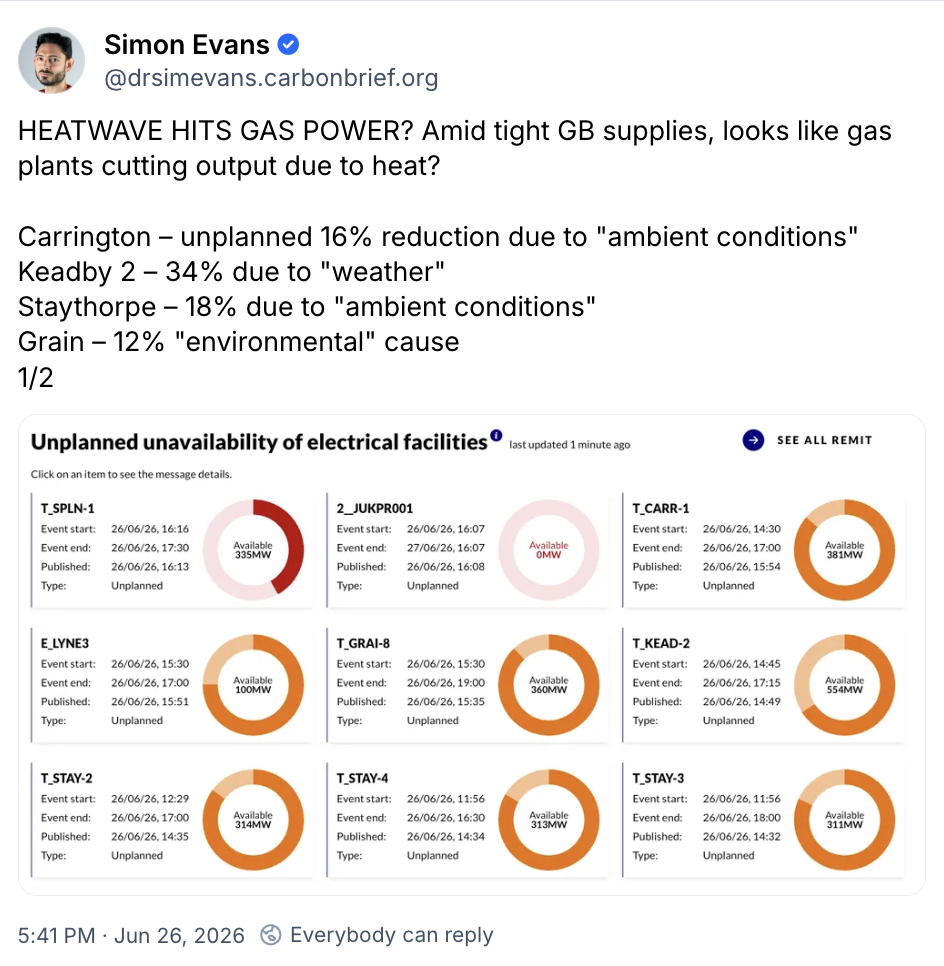
Dr Staffell adds that gas power stations are thought of as “reliable, because of the way we use them” in the UK.
Whereas wind and solar are usually used to the maximum extent possible, he says that on average, only around 40% of the gas fleet is in use at any one time. As such, even if the efficiency of one gas power plant is affected by high temperatures, “we have a lot of slack to call on more of them to run”. He adds:
“The issue is less that they can’t deliver, but we have to pay through the nose to persuade more to turn on at critical times, adding to sky-high energy bills.”
Wind
The impact of heatwaves on wind generation is less direct than for other technologies.
However, wind speeds often drop during heatwaves, which tend to build during periods of sustained high pressure into extreme events such as “heat domes”.
Dr Staffell, explains to Carbon Brief:
“The very hottest days tend to create heat domes with very low wind speeds, which directly reduces the output that windfarms can produce. Air is also less dense the hotter it is, so it carries less energy within it, so there is a double impact on wind turbines.”
High temperatures are linked to low wind speeds across three-quarters of the globe, according to one recent study, looking at data from 1980 to 2023.
The study found that, as a result, across Australia, northern Asia and Europe, wind power decreased by an average of 30-50% during heatwaves.
This is inconsistent globally, however, with the Amazon, the Great Plains in North America and central Africa actually seeing a slight increase in wind during high temperatures.
As such, while the effect of heatwaves on wind generation is less direct than other generation technologies, it can have a significant impact.
In the UK in June 2026, wind generation fell to around 15% of the electricity mix due to low wind speeds, from an average for the month of about 30%, according to Octopus.
Low wind generation during this period was a key feature of the strain on the grid experienced during this time – in particular, as demand rose amid record-high temperatures.
On Wednesday 24 June, for example, the National Electricity System Operator (Neso) had to pay high prices to balance supply and demand. This included paying as much as £1,400 a megawatt-hour to secure around 1.7 gigawatts (GW) of imported power, nearly 20 times the average price for electricity in June 2025.
A Neso spokesperson said in a statement: “This is due to the impact of extremely high temperatures affecting Great Britain and the continent, and low wind.”
While reduced wind generation is common during a heatwave, it is not generally viewed as a concern for energy system operators. This is due to wind following well-established seasonal patterns – it generates less power in summer than in winter – as well as being complementary to other renewable technologies, such as solar.
Dr Chris Rosslowe, senior energy analyst for Europe at Ember, tells Carbon Brief:
“Power systems are less reliant on wind power in the summer months and its lower-than-average output is already expected and planned for. Heatwaves often bring still, but clear conditions, highlighting the benefit of wind and solar as a duo – poor conditions for one often mean good conditions for the other.”
As such, wind power remains one of very few technologies considered “resilient” to heatwaves by the UK government.
However, this did not stop the anti-renewables Daily Mail from attempting to blame the technology for strain on the UK grid on 24 June 2026, despite its own article acknowledging that gas plants had also been forced to cut their output by 2.5GW on the day.
Solar
Another common claim seen in the media is that solar “struggles” during heatwaves, with high temperatures pushing down the technology’s efficiency.
Yet heatwaves tend to coincide with long, cloudless days, when solar generation is reliably above average – despite the impact of high temperatures.
While hot weather does reduce the efficiency of solar cells, the effect is relatively modest – and widely understood. Each 1C of temperature rise reduces output by around 0.4-0.5%, according to a recent study.
This is in line with an evidence review for the UK government, which suggests the performance of solar panels falls by 0.2-0.5% for every degree of heat above 25C.
Generally, however, this effect is easily outweighed by high sunlight hours during hot spells. For example, across a four-day heatwave in the UK in June 2026, solar generated 484 gigawatt-hours (GWh) of electricity – a 46% increase over the same period a week earlier.
Similar generation highs were seen across Europe, amid record temperatures and dangerous heat that was pushing people towards the use of air conditioning.
Solar generated a record 52TWh across the EU in June 2026, beating the high set just the month before of 47TWh.
In fact, solar – especially when combined with battery storage – is a complementary technology to air conditioning, given their similar seasonal patterns. Over the course of the day, demand from air conditioning and generation from solar also marry up well.
Dr Rosslowe says:
“Solar, battery storage and air conditioning are a highly complementary trio of technologies during heatwaves. There’s a high overlap between solar output and demand from AC.”
For example, on the hottest day of the year so far in Great Britain (the island grid serving England, Wales and Scotland), on 26 June 2026, solar surged to 13.9GW in the middle of the afternoon, as demand also hit its highest point, as shown in the chart below.
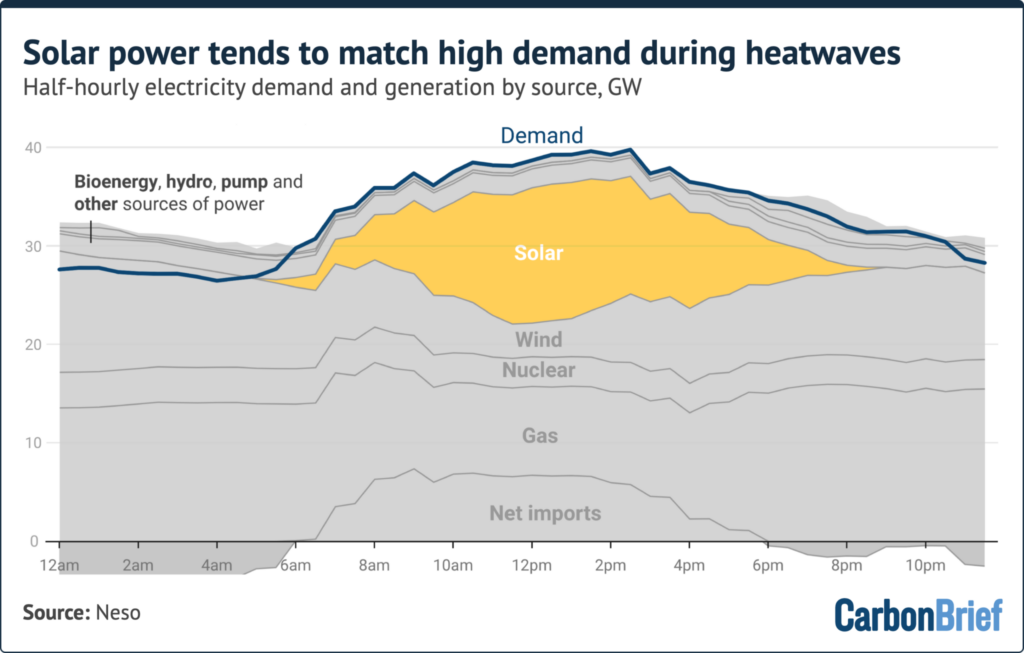
Generation on the 26 June in Great Britain, highlighting the match between solar power (yellow) and the demand profile for electricity (blue line). Source: Neso.
Across June 2026, homes with solar panels generated the equivalent of five hours of “free” self-supplied air conditioning, according to recent analysis.
Despite the impact of heat on solar efficiency, the technology is, therefore, well placed to bolster energy systems during heatwaves.
Indeed, as Dr Rosslowe tells Carbon Brief, solar suppresses power prices during daylight hours. But, even though it is predictable, there are still challenges around managing the dip in solar generation as the evening sets in. This is often compounded because it coincides with the usual evening increase in demand.
Dr Rosslowe explains:
“Problems arise when the sun goes down, but demand for cooling remains high. In the early evening hours, when gas power typically ramps up to replace solar, we have seen prices spike to extreme levels, made worse by high international gas prices.”
Storage
Energy storage systems are increasingly key to managing the impact of heatwaves on electricity systems.
The category of technologies is dominated by batteries, with more than 108GW of battery storage added in 2025 alone, according to the International Energy Agency.
Already, batteries have been used to take advantage of surges in solar generation during the daytime, amid high summer temperatures.
This is particularly useful to meet evening peaks in electricity demand, as well as the need for air conditioning overnight when temperatures do not fall.
In a statement, Pawel Czyzak , Europe programme director at Ember, said:
“Heatwaves will not go away – they will only get more severe in the future. Solutions that can help mitigate their impacts, such as battery storage, interconnection, demand flexibility and dynamic tariffs, should become a key part of grid planning and power market design.”
However, batteries are not without their challenges during heatwaves. Battery performance also decreases as temperatures exceed their optimal level.
Additionally, high temperatures can accelerate the degradation of components in lithium-ion batteries, which dominate the sector.
Analysis for the UK government found that prolonged operation at very high temperatures could – at least in theory – “overwhelm” the cooling systems built into batteries, “posing risks such as thermal runaway and explosions”. However, it noted that in practice, these cooling systems are “routinely” designed to handle temperatures of up to 45C.
(The analysis added that “developers and manufacturers have a strong understanding of risk to [battery storage systems] from high temperature and mitigate risks through regular maintenance, design improvements, and passive cooling strategies”.)
Other storage technologies also face challenges during heatwaves. For example, pumped hydro storage can be significantly impacted by drought.
Australia – which now has 4.3GW of large-scale battery storage capacity – saw its fleet of batteries and pumped hydro storage tested at the beginning of 2026, amid the most severe heatwave in years.
Temperatures above 40C posed “challenges” to storage technologies, reported Energy Storage News, which explained that their output and operating times were reduced by the increased need for their cooling systems to operate.
Despite these challenges, the use of battery storage is helping to spread the ability of renewables to meet electricity demand during heatwaves. For example, a combination of solar and battery energy storage “kept the lights on” in California amid a heatwave in 2024.
By storing abundant power during the day, it can be discharged during evening peaks, helping to minimise generation constraints and thereby keep power prices down.
Dr Rosslowe says:
“The extreme price spikes that we witness during heatwaves are a blaring signal for more power system flexibility. That could come from battery storage, demand response, or increased interconnection between countries or regions.”
Here are some “ETs” recorded from around the U.S. the last couple of days, their consequences, and some extreme temperature outlooks, as well as any extreme precipitation reports:
Here is More Climate News from Thursday:
(As usual, this will be a fluid post in which more information gets added during the day as it crosses my radar, crediting all who have put it on-line. Items will be archived on this site for posterity. In most instances click on the pictures of each tweet to see each article. The most noteworthy items will be listed first.)